Events

Upcoming shows
10/14/10Fall Membership LuncheonPrivate Venue
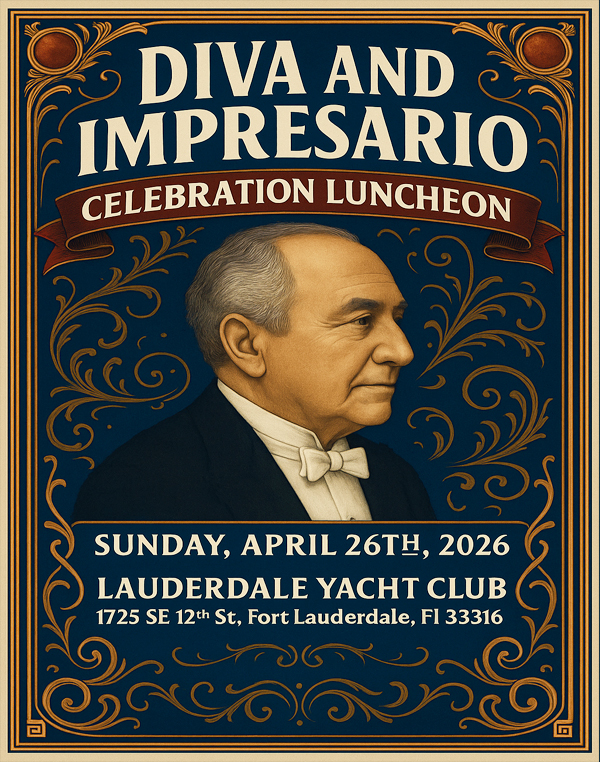
10/27/10Diva Impresario Honoree, Liaison, Hostess Working BrunchCoral Ridge Yacht Club
11/03/10Guess Who's Coming To Dinner Sign-UpJosephine S. Leiser Opera Center
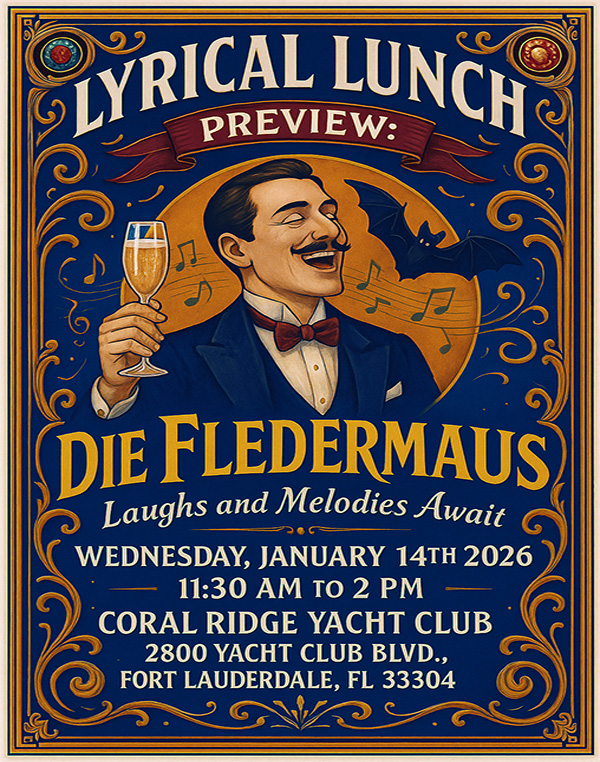
11/09/10Lyrical LuncheonJosephine S. Leiser Opera Center
01/11/11Lyrical LuncheonJosephine S. Leiser Opera Center
02/17/11The 18th Annual Diva Impresario Awards LuncheonHyatt Regency Pier Sixty-Six
03/23/11The Mad Hatter's High Tea at Noon
05/04/11Spring Membership Luncheon & Installation of Officers
Past show archive
05/05/10Installation of OfficersPier Top Hyatt Regency Pier Sixty Six
04/18/10Treasures Old and NewJosephine S. Leiser Opera Center
04/17/10Treasures Old and NewJosephine S. Leiser Opera Center
04/13/10Lyrical LuncheonJosephine S. Leiser Opera Center
03/25/10Young Artist RecitalBonnet House
03/10/10The Mad Hatter's TeaTower Club
02/09/1017th Annual Diva Impresario Awards LuncheonHyatt Regency Pier Sixty-Six
01/05/10Lyrical LuncheonLauderdale Yacht Club
11/05/09Lyrical LuncheonCoral Ridge Country Club
10/28/09Diva Impresario Hostess Working BrunchCoral Ridge Yacht Club
10/15/09Fall Membership LuncheonPrivate Venue
05/01/09Installation of Officers and Membership LuncheonCoral Ridge Yacht Club
04/17/09Young Artist Art Song RecitalJosephine S. Leiser Opera Center
04/03/09Cultural Humanitarian Awards DinnerTower Club
03/18/09Mad Hatters' Afternoon TeaThe Ritz-Carlton
03/13/09Young Artist Art Song RecitalJosephine S. Leiser Opera Center
02/17/09Diva Impresario Awards LuncheonHyatt Regency Pier Sixty-Six
02/13/09Young Artist Art Song RecitalJosephine S. Leiser Opera Center
01/26/09Luxurious Lyrical Libations: Tango and TapasJosephine S. Leiser Opera Center
01/17/09Family Day PerformanceAlvin Sherman Library
01/08/09Young Artist ConcertBonnet House
12/15/08Luxurious Lyrical Libations: Cafe au LaitJosephine S. Leiser Opera Center
12/02/08Young Artist RecitalJosephine S. Leiser Opera Center
11/17/08Luxurious Lyrical Libations: A TeaJosephine S. Leiser Opera Center
10/28/08Diva Honoree, Liaison, Host and Hostess BrunchCoral Ridge Yacht ClubBy invitation
10/22/08Fall Membership LuncheonPrivate Venue
04/06/08Cherries Jubilee LuncheonWesterdam
04/05/08Cherry Jubilee Masquerade DinnerCarol and Ben Harrison’s ManseOriental Costume Gala
04/04/08Cherry Vodkatini Cocktail PartyJosephine S. Leiser Opera CenterFashion Show
Powered by Blogs for Bands Silk icons by Mark James
CINEMA PARADISO SCHEDULE 2010

SUNDAY, AUGUST 22, 1pm

GOTTERDAMMERUNG (Richard Wagner)

Performed at Palau de les Arts, Reina Sofia, Valencia, Spain

Conducted by Zubin Mehta

Directed by Carlus Padrissa and La Fura del Baus

Starring Lance Ryan, Jennifer Wilson and Franz-Josef Kapellmann

German with English subtitles
4 hrs 40 mins with two intermissions

Part of Der Ring from Valencia

Götterdämmerung (or “the Twilight of the Gods”) is the fourth and final opera in Wagner’s tetrology, Der Ring des Nibelungen. The Ring Cycle (as it is commonly called) is a monolithic landmark in music history. It is often said to be the embodiment of the concept of Gesamtkunstwerk, or “complete art work,” a term Wagner adopted to describe a work of art that incorporates all areas of artistic expression: dance, drama, music, visual arts, etc. Certainly The Ring qualifies: the combined operas are 15 hours of continuous music, with words written by Wagner himself. The emotional and dramatic power of the music lies in one of Wagner’s greatest innovations, the leitmotif. The leitmotifs are musical themes with specific dramatic associations. For instance, every time someone is singing about Valhalla, the home of the gods, the Valhalla leitmotif plays, conjuring up the grandeur of their palace. The concept of leitmotifs has expanded far beyond the opera house. For example, film score composer John Williams wrote a leitmotif for Darth Vader that instantly conjures up his evil visage. Wagner uses leitmotifs to great effect by allowing the orchestra to comment on the action on stage, almost as another character in this epic drama; as a result, his music adored by both opera and orchestral music fans alike.

In this production, the Barcelona-based La Fura dels Baus, headed up by director Carlus Padrissa, blends music, dance, acrobatics and technology into unforgettable stage events of raw but always captivating power. The Fura made its breakthrough in the classical establishment with its production of Berlioz’s La damnation de Faust at the 1999 Salzburg Festival.

Musically, this Ring is on a par with productions from historically more prestigious opera houses. Legendary conductor Zubin Mehta leads promising young talents, including Jennifer Wilson (Brünnhilde) and Juha Uusitalo (Wotan), whom the Frankfurter Allgemeine Zeitung hailed as a new “number one among the opera gods.” Equally outstanding is the Orquestra de la Comunitat Valenciana, an ensemble of top musicians hand-picked by Music Director Lorin Maazel.

Synopsis:

PROLOGUE. On the Valkyries’ Rock, the three Norns spin the rope of Fate, as they recall Wotan’s former power and predict the end of the Gods. The rope breaks, and they descend to their mother Erda, the goddess of the Earth. Siegfried his bride, the former Valkyrie Brünnhilde, emerge from their cave. Brünnhilde fears losing her husband, but still sends him off into the world. They exchange tokens of love: he gives her the magic Ring, and she gives him her horse Grane.

ACT I. Gunther and his sister, Gutrune, plot to secure the Ring with their half-brother Hagen (the son of the the Nibelung, Alberich). Hagen suggests that they slip a potion in Siegfried’s drink to make him forget Brünnhilde, and then have him marry Gutrune. When Siegfried arrives, they execute their plan. Siegfried forgets his true bride, and immediately agrees to marry Gutrune. Back at the Valkyries’ rock, Brünnhilde is joined by her sister Waltraute, who tries to convince Brünnhilde to give her back the Ring, so that they may save the Gods from destruction. Brünnhilde refuses, saying that her mortal bond to Siegfried is more important than the Gods. Waltraute leaves empty-handed. Siegfried arrives, transformed into the shape of Gunther by the power of the Tarnhelm. He claims the terrified Brünnhilde as Gunther’s bride and tears the Ring from her finger.

ACT II. At night, Hagen dreams of his father Alberich, who demands that he regains the Ring. The next morning, Siegfried returns with Brünnhilde in tow, and gives her to the real Gunther. Brünnhilde is shocked at seeing the Ring on Siegfried’s hand, and realizes his deception. Siegfried, still enchanted, dismissed Brünnhilde’s anger and leaves with Gutrune. As vengeance, Brünnhilde tells Hagen how to kill Siegfried – by stabbing him with a spear in his back. Gunther, enticed by the Ring, joins the murder plot. The couples proceed to the wedding feast.

ACT III. On the bank of the Rhine the three Rhinemaidens mourn their lost gold. Siegfried wanders to the banks, separated from his hunting party. The Rheinmaidens beg for him to give back the gold, but he refuses. Soon he is met by Hagen, who asks Siegfried to tell him his life story: from his childhood with Mime, his slaying of the dragon Fafner, and then (as Hagen restores his memory), his wooing of Brünnhilde. Feigning jealousy, Hagen stabs Siegfried in the back. Remembering his true love to Brünnhilde with his final breath, he dies. Back at the castle, Hagen tells Gutrune that Siegfried was killed by a wild boar. When his body is borne in, she sees the obvious stab wound and accuses Hagen of murder. He admits to the crime, and then kills Gunther when they fight over the Ring. He backs in away in horror, however, when the dead Siegfried raises his hand. Brünnhilde enters and orders a funeral pyre for Siegfried. She blames his death on the Gods, takes the Ring, and promises it to their rightful owners – the Rheinmaidens. She places it on her finger and throws herself into the flames. The Rheinmaidens drag Hagen to his death in the Rhine. The Gibichung Hall and Valhalla are consumed with flames, destroying the world of the Gods. The human world remains, purified by Brünnhilde’s love.

Siegfried – Lance Ryan
Gunther – Ralf Lukas
Alberich – Franz-Josef Kapellmann
Hagen – Mattil Salminen
Brünnhilde – Jennifer Wilson
Gutrune – Elisabete Matos
Waltraute – Catherine Wyn-Rogers
First Norn – Daniela Denschlag
Second Norn – Pilar Vázquez
Third Norn – Eugenia Bethencourt
Woglinde- Silvia Vázquez
Wellgunde – Ann-Katrin Naidu
Flosshilde – Marina Prudenskaja

> SUNDAY, AUGUST 22, 1pm

+++++++++++++++++++++++++++++++++++++++

SUNDAY, SEPTEMBER 19

TOSCA (Puccini)
Performed at Teatro Carlo Felice, Genoa, Italy

Conducted by Renzo Giacchieri

Sung in Italian with English subtitles

CAST:
Daniela Dessì (Tosca)
Fabio Armiliato (Cavaradossi)
Claudio Sgura (Scarpia)
Enrico Iori (Angelotti)
Armando Gabba (Sagrestano)
Mario Bolognesi (Spoletta)
Angelo Nardinocchi (Sciarrone)
The chorus (A jailer)

Tosca is an opera in three acts by Giacomo Puccini to an Italian libretto by Luigi Illica and Giuseppe Giacosa, based on Victorien Sardou’s drama, La Tosca. The work premiered at the Teatro Costanzi in Rome on January 14, 1900. It is one of the world’s most popular operas, a hit with audiences from its first performance. However it was not well received at first by critics.

Today, Tosca is a staple of the standard operatic repertoire and appears as number eight on Opera America’s 2008 list of the 20 most-performed operas in North America.

+++++++++++++++++++++++++++++++++++++++

SUNDAY, OCTOBER 17

THE QUEEN OF SPADES (Tchaikovsky)
Performed at the Gran Teatre del Liceu

Conducted by Michael Boder

Sung in Russian with English subtitles
200 minutes and two intermissions

CAST:
Emily Magee (Lisa)
Ben Heppner (Gherman)
Lado Ataneli (Tomsky/Zlatogor)
Ludovic Tézier (Prince Yeletsky)
Ewa Podlés (The Countess)
Elena Zaremba (Pauline)
Francisco Vas (Chekalinsky)
Alberto Feria (Tsurin)
Mihail Vekua (Chaplitsky)
Kurt Gysen (Narumov)
Stefania Toczyska (The Governess)
Claudia Schneider (Masha)
Jon Plazaola (The Master of Ceremonies)
Michelle Marie Cook (Prilepa)

Queen of Spades is an opera in three acts by Pyotr Ilyich Tchaikovsky to a Russian libretto by the composer’s brother Modest Tchaikovsky, based on a short story of the same name by Alexander Pushkin. The management of the Imperial Theatre offered a commission to Tchaikovsky to write an opera based on the plot sketch by Ivan Vsevolozhsky in 1887/88. After turning it down initially, Tchaikovsky accepted it in 1889.

The premiere took place in 1890 in St. Petersburg, Russia.

ACT I
Two soldiers, Chekalinsky and Tsurin, stroll through the park. They discuss how another soldier, Gherman, never gambles, despite obsessively watching others play. Accompanied by his friend Tomsky, Gherman appears and bemoans the fact that he is in love with a girl far above his station, whose name he doesn’t even know. The Prince Yeletsky arrives with his bride-to-be, Lisa, and her grandmother, the Countess. While Yeletsky is overjoyed at his recent engagement, Gherman is distraught—Lisa is the woman he has loved from afar! After Yeletsky and the ladies leave, the soldiers recount how, as a beautiful young woman, the Countess traded affection to learn a trick to always win at cards. Because of this, the Countess was nicknamed the Queen of Spades. Only two men ever learned the secret, and she was warned by an apparition to beware the “third suitor,” who would try to discover the trick. Gherman sees the Countess’ knowledge as a way to solve both his financial and romantic problems, and resolves to learn her secret.

At home, Lisa and her friends play music and dance. However, Lisa is somewhat distracted and aloof. Soon, her Governess shoos away her friends, including her friend Pauline, who encourages Lisa to cheer up. Lisa asks her maid, Masha, to leave the windows to her room open so she can enjoy the night breezes. Alone, Lisa expresses her unhappiness about the engagement, and her strange attraction to the man at the park who was staring at her—Gherman. Just as she thinks of him, Gherman appears at her window, and threatens to kill himself out of grief if she marries another. Lisa brings him into the room, but then a knock at the door forces him to hide. It is the Countess, telling Lisa to close her windows and go to sleep. After the Countess departs, Lisa asks Gherman to leave, but then succumbs to her desire, and they fall into each other’s arms.

ACT II
A little while later, at a masqued ball, Gherman’s friends comment on how obsessed he has become with the secret of the cards. Yeletsky, seeing Lisa sad and listless, tries to cheer her up by reminding her how much he loves her. Lisa surreptitiously gives Gherman the key to her grandmother’s room, telling him that the Countess will be gone all the next day. However, Gherman insists upon coming that very night, thinking that destiny will lead him to discover the secret of the cards. He sneaks into the Countess’ room and admires a portrait of her as a young woman. He hears her approaching and hides. When she dozes off, Gherman creeps out and wakes her, begging to be taught her secret. When she doesn’t answer, Gherman threatens her with a pistol, and she dies of fright. Lisa rushes in, and finds to her horror that the man to which she gave her love was really more interested in learning her grandmother’s secret. Lisa orders Gherman to leave, and collapses into sobs.

ACT III
Alone in the barracks, Gherman reads a note from Lisa asking him to meet her by the river at midnight. The ghost of the Countess appears, and reluctantly agrees to tell Gherman her secret, as it is the only way to save Lisa. He listens as she reveals the cards: three, seven, ace.

Lisa waits by the near-frozen river, lamenting that even though Gherman may still love her, her hopes of happiness are gone. Soon Gherman appears, and although he offers a few words of reassurance, he quickly begins babbling about the Countess and the secret, until he no longer even recognizes Lisa, and abandons her. Lisa, realizing that her life has been ruined, throws herself into the icy river.

The military officers gamble at a tavern nearby, joined by Yeletsky, who has never gambled before, but does now, because his engagement has been broken off. The mood is festive until the wild-eyed Gherman enters, intent on gambling. He immediately lays a heavy bet on three and wins, disturbing others with his crazed expression. He bets the seven and again wins, taking a wine glass in his hand and declaring that “life is but a game.” Finally, on the last hand, he bets the ace, but Yeletsky’s card beats him—the queen of spades. Once again seeing the ghost of the Countess, Gherman commits suicide, asking for forgiveness from both Yeletsky and Lisa.

General Admission $20 | FLIFF and FGO members $15

PAST OPERAS

SIMON BOCCANEGRA (Verdi)
Performed at Teatro all Scala, in co-production with Staatsoper unter den Linden, Berlin.

Conducted by Daniel Barenboim

Sung in Italian with English subtitles
175 minutes and one intermission

CAST:
Simon Boccanegra Plácido Domingo
Jacopo Fiesco Ferruccio Furlanetto
Amelia Anja Harteros
Gabriele Adorno Fabio Sartori
Paolo Albiani Massimo Cavalletti
Pietro Ernesto Panariello

Program note: Simon Boccanegra premiered at Teatro La Fenice in Venice on March 12, 1857 but the version that is performed near-universally today is the revised version, which Verdi presented at Teatro alla Scala on March 24, 1881 – over twenty years later! The composer considered the first incarnation too dark and “too sad.” The need for revision united Verdi with librettist Arrigo Boito, who would become his favorite librettist. The most substantial addition to the opera was the famous Council Chamber scene, which gave the character of Simon Boccanegra (the Doge of Genoa) greater dramatic power and presence within the world of the opera. This production from La Scala stars the inimitable Plácido Domingo in the title role – a noteworthy turn, given that Domingo has been a tenor his entire career, and the Doge is solidly a baritone role!

Synopsis: Simon Boccanegra is the Doge of Genoa, but twenty-five years earlier he fathered a child with Marie, the daughter of his then-political rival Fiesco. Marie died while still young, and their infant daughter disappeared. Ever since Boccanegra came to power, Fiesco has lived under an assumed name out in the country with his adopted daughter Amelia. “Amelia” is actually Boccanegra’s daughter, and thus Fiesco’s granddaughter, but at first neither man knows it. Fiesco attempts to give her in marriage to man she doesn’t love, but once Boccanegra find out her true identity, he lobbies to have her wed to her true love, Gabriele, even though Gabriele has been secretly plotting against the Doge with the exiled Fiesco. Gabriele and Fiesco still do not know Amelia’s true identity, so they continue with their plans to kill the Doge. Boccanegra is tricked into drinking poison by one of Fiesco’s friends, but shortly before he dies, Amelia’s identity is revealed to Gabriele, who begs the Doge for forgiveness. The benevolent Boccanegra forgives him and blesses the marriage of Gabriele and Amelia. Soon, Fiesco also finds out Amelia’s lineage, and when the Doge dies, everyone—even his former rivals—mourn the passing of the great man.

General Admission $20 | FLIFF and FGO members $15

+++++++++++++++++++++++++++++++++++++++

July 18, 1pm

The Abduction from the Seraglio (Mozart)
From the Gran Teatre del Liceu, Barcelona

The Abduction from the Seraglio; also known as Il Seraglio) is an opera Singspiel in three acts by Wolfgang Amadeus Mozart. The German libretto is by Christoph Friedrich Bretzner with adaptations by Gottlieb Stephanie. The plot concerns the attempt of the hero Belmonte, assisted by his servant Pedrillo, to rescue his beloved Konstanze from the seraglio of the Pasha Selim.

The company that first sponsored the opera was the Nationalsingspiel (“national Singspiel”), a pet project (1778–1783) of the Austrian emperor Joseph II. The Emperor had set up the company to perform works in the German language (Italian opera was already popular in Vienna). This project was ultimately given up as a failure, but along the way it produced a number of successes, mostly a series of translated works. Mozart’s opera emerged as its outstanding original success

The piece is a middle-weight Mozart opera; it isn’t one of his greatest hits, but it isn’t a forgotten or dismissed work either. The average opera fan is familiar with this work, (as it is performed frequently all over the world,) but it’s unlikely that a novice opera-goer or “non-opera person” would recognize any of the melodies. However, it’s still an accessible and “friendly” opera – upbeat songs, impressive singing, simple plot and a happy ending.
The style of this production falls somewhere between traditional and contemporary – the singers are dressed as if they’re from the early 20th century (not the 17th century as Mozart intended), giving the impression that the action takes place in some vague, unspecified past. The pared-down scenery adds to this “timeless” effect. The locale is also muted. Mozart wrote this at a time when all things Turkish were very poplar. There is still Turkish influence evidenced in the music, but this production lacks the caricaturized Turkish costumes and sets that would indicate an “exotic” setting.

General Admission $20 | FLIFF and FGO members $15

+++++++++++++++++++++++++++++++++++++++


+++++++++++++++++++++++++++++++++++++++


Leave a Comment

Please leave these two fields as-is: